
Emails enviados!
Como fazer:
To the Government of the People's Republic of China,
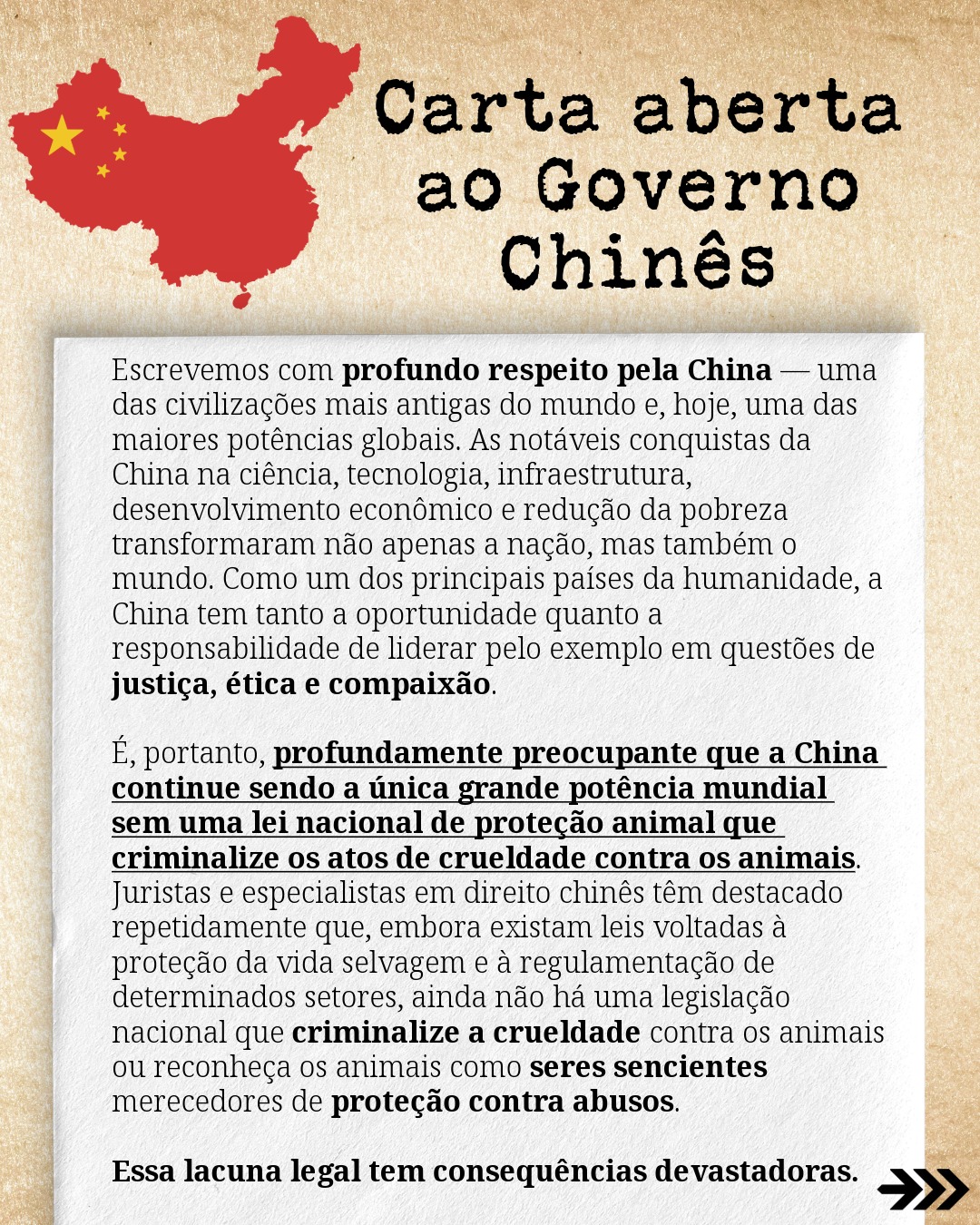
I write with profound respect for China — one of the world’s oldest civilizations and, today, one of the greatest global powers. China’s remarkable achievements in science, technology, infrastructure, economic development, and poverty reduction have transformed not only the nation itself, but also the world. As one of humanity’s leading countries, China has both the opportunity and the responsibility to lead by example on matters of justice, ethics, and compassion.
It is therefore deeply concerning that China remains the only major global power without a national animal protection law that criminalizes acts of cruelty against animals. Chinese legal scholars and experts have repeatedly emphasized that, although there are laws aimed at protecting wildlife and regulating certain sectors, there is still no national legislation that criminalizes cruelty against animals or recognizes animals as sentient beings deserving protection from abuse.
This legal gap has devastating consequences.
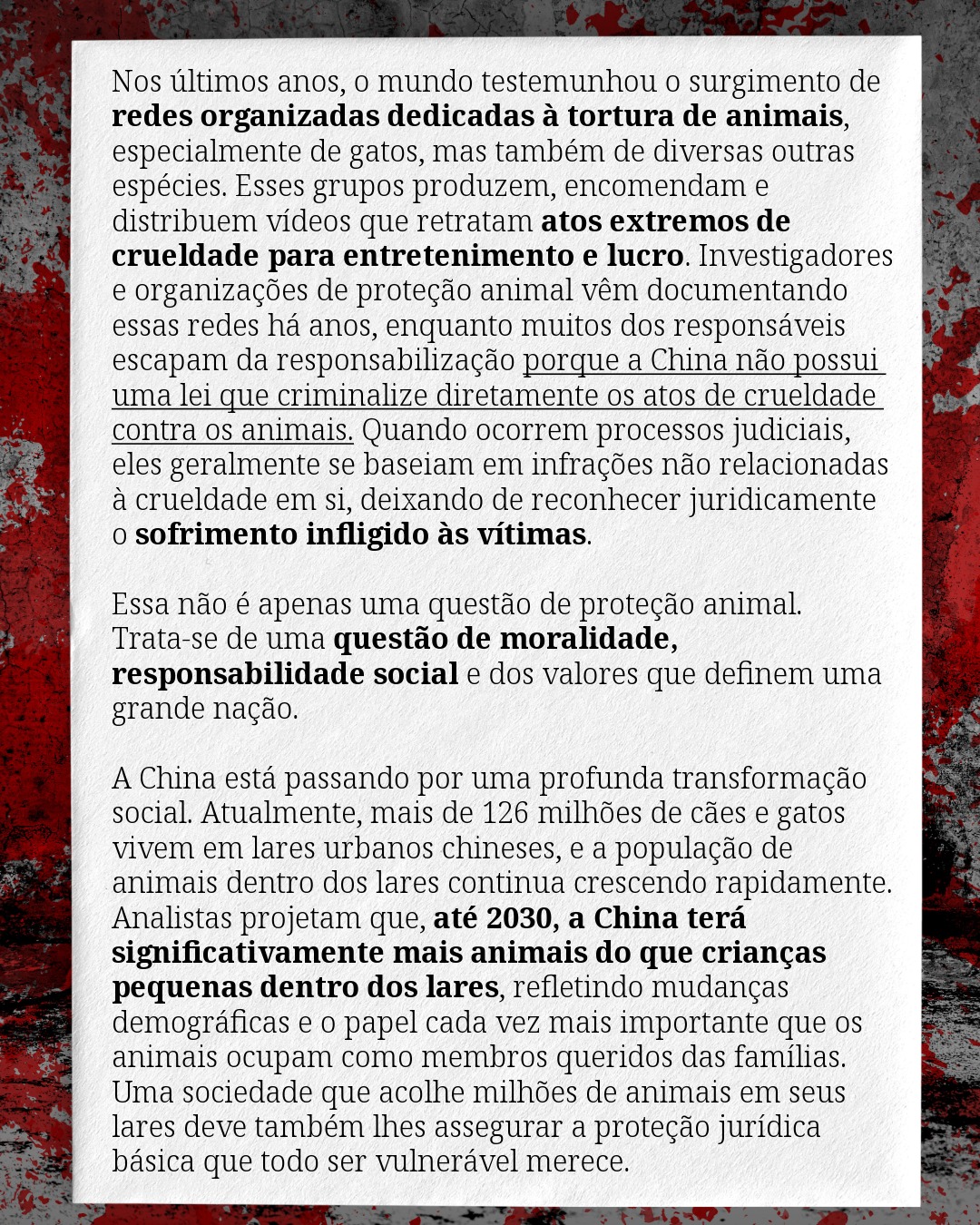
In recent years, the world has witnessed the emergence of organized networks dedicated to the torture of animals, particularly cats. These groups produce, commission, and distribute videos depicting extreme acts of cruelty for entertainment and profit. Investigators and animal protection organizations have been documenting these networks for years, while many of those responsible escape accountability because China has no law that directly criminalizes acts of cruelty against animals. When legal proceedings do occur, they are generally based on offenses unrelated to the cruelty itself, failing to legally recognize the suffering inflicted upon the victims.
This is not merely an animal protection issue. It is a matter of morality, social responsibility, and the values that define a great nation.
China is undergoing a profound social transformation. Today, more than 126 million dogs and cats live in Chinese urban households, and the population of companion animals in homes continues to grow rapidly. Analysts project that, by 2030, China will have significantly more animals than young children in households, reflecting demographic changes and the increasingly important role that animals play as beloved members of families. A society that welcomes millions of animals into its homes must also provide them with the basic legal protection that every vulnerable being deserves.
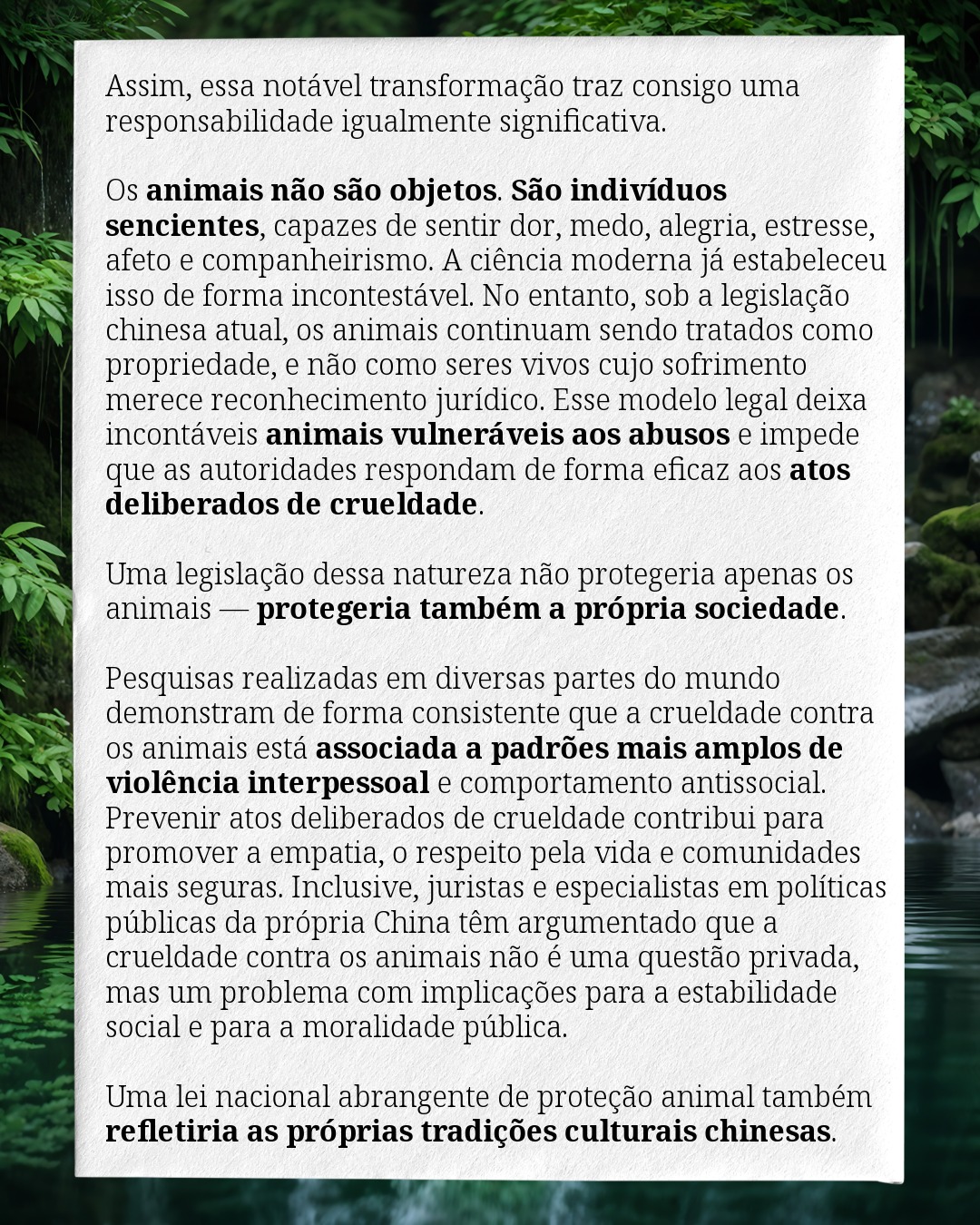
Thus, this remarkable transformation brings with it an equally significant responsibility.
Animals are not objects. They are sentient individuals capable of experiencing pain, fear, joy, stress, affection, and companionship. Modern science has already established this beyond dispute. Yet, under current Chinese law, animals continue to be treated as property rather than as living beings whose suffering deserves legal recognition. This legal framework leaves countless animals vulnerable to abuse and prevents authorities from responding effectively to deliberate acts of cruelty.
Legislation of this nature would not only protect animals — it would also protect society itself.
Research conducted in various parts of the world consistently demonstrates that extreme cruelty toward animals is associated with broader patterns of interpersonal violence and antisocial behavior. Preventing deliberate acts of cruelty helps promote empathy, respect for life, and safer communities. Chinese legal scholars and public policy experts themselves have argued that animal cruelty is not a private matter, but a problem with implications for social stability and public morality.
A comprehensive national animal protection law would also reflect China’s own cultural traditions. For centuries, Chinese philosophy has emphasized compassion, benevolence, harmony between humanity and nature, and respect for all forms of life. These values continue to be deeply admired around the world and deserve to be reflected in contemporary legislation.
As a global superpower, China’s influence extends far beyond its borders. Nations look to China as a model in technology, trade, infrastructure, and international development. However, leadership is measured not only by economic strength, but also by moral progress. The greater a nation’s power, the greater its responsibility to protect the vulnerable and promote justice.
The passage of a comprehensive national animal protection law that recognizes animal sentience and criminalizes acts of cruelty would send a powerful message to the world: that China chooses solidarity and justice alongside prosperity, and responsibility alongside strength and progress.
On behalf of animal advocates and compassionate citizens around the world, we respectfully call upon the Government of the People’s Republic of China to pass and implement a comprehensive national animal protection law that recognizes animals as sentient beings, criminalizes acts of cruelty, dismantles organized networks involved in the torture of animals, and ensures that all animals in China receive the legal protection they deserve.
History remembers great nations not only for what they built, but also for what they chose to protect.
We sincerely hope that China will become a world leader in compassion toward all forms of life, giving a voice, through the law, to those who cannot speak for themselves.
Respectfully,